
Successfully exporting to the EU is less about checklists and more about strategic arbitrage—turning the market’s complexity into a competitive advantage that the US market cannot offer.
- The Canada-European Union Comprehensive Economic and Trade Agreement (CETA) provides a structural edge, not just tariff removal.
- Logistical success hinges on choosing a strategic “gateway” into the single market, rather than just a shipping method.
- Cultural and regulatory differences are not barriers but opportunities to build a defensible market position.
Recommendation: Shift your perspective from simply ‘selling to Europe’ to building a resilient, high-margin export strategy by leveraging the unique characteristics of the EU single market.
For many Canadian manufacturers, looking beyond our borders for growth inevitably leads to the United States. It’s a familiar, proximate, and massive market. Yet, true diversification and long-term resilience often lie across the Atlantic. The European Union, with its vast and affluent consumer base, presents a monumental opportunity, but it’s one that is frequently misunderstood. Many businesses approach it with a simple checklist mentality: translate a website, find a shipper, and hope for the best. This approach is a recipe for failure.
The common advice focuses on navigating CETA’s tariff reductions or adapting marketing materials. While important, these are merely table stakes. The real challenge—and opportunity—is more profound. It involves a fundamental shift in mindset. What if the EU’s stringent regulations were not a barrier, but a “regulatory moat” that, once crossed, protects you from less committed competitors? What if its cultural diversity was not a headache, but a series of niche markets where a tailored approach could command premium pricing?
This guide moves beyond the platitudes. It is designed for the Canadian business leader who understands the basics and is now asking the strategic questions. We will not just cover the ‘what’ of exporting to the EU; we will explore the ‘why’ behind the critical decisions. This is not about just following rules, but about making deliberate trade-offs. It’s about leveraging the structural advantages CETA provides against the EU’s inherent complexity to build a defensible and profitable European presence.
This article is structured to first provide a deep dive into the specifics of EU market entry, from leveraging trade agreements to managing logistics and currency. It then broadens the perspective to other strategic challenges Canadian businesses face, reminding us that a global mindset is built on mastering complexities both at home and abroad. Explore the sections below to build your strategic roadmap.
Summary: A Strategic Roadmap for Exporting to the EU and Beyond
- Why CETA Gives Canadian Businesses an Edge in Europe?
- How to Logistics: Shipping Products from Canada to Europe Without Headaches?
- US vs. EU: Which Export Market Is Easier for Canadian SMEs?
- The Localization Mistake That Can Offend Your European Clients
- When to Hedge Currency Risks: Protecting Margins Against a Fluctuating Euro
- Why Products That Work in the US Often Fail in Canada?
- How to Use Vancouver as a Hub for Exporting to Asian Markets?
- How to Succeed in Vancouver’s Real Estate-Driven Business Landscape?
Why CETA Gives Canadian Businesses an Edge in Europe?
The Canada-European Union Comprehensive Economic and Trade Agreement (CETA) is far more than a simple tariff-reduction plan; it’s a foundational strategic advantage for Canadian businesses. While competitors from other nations face a wall of duties and complex regulations, CETA provides a preferential pathway. The most cited benefit is that 99% of EU tariff lines are now duty-free for Canadian goods, immediately making your products more price-competitive. This direct cost saving can either be passed on to the consumer to gain market share or reinvested into marketing and distribution to accelerate growth.
Beyond tariffs, CETA creates a more predictable and stable business environment. One of its most powerful, yet underappreciated, aspects is the access it grants to government procurement. This opens up an estimated $3.3 trillion market, allowing Canadian firms to bid on public contracts at all levels of EU government—a market previously closed off. Furthermore, the agreement facilitates the movement of skilled professionals, making it easier for Canadian engineers, IT specialists, and consultants to work on projects within the EU. This mobility is critical for service-based businesses and for companies needing to deploy technical staff for installation or support.
The impact is not just theoretical. CETA has been a significant catalyst for small and medium-sized enterprises (SMEs). Data from Carleton University shows a clear trend of growth, with the number of Canadian SME exporters to the EU expanding from 7,295 in 2016 to 7,787 in 2019. This demonstrates that the agreement is effectively enabling smaller firms, not just large corporations, to tap into the European market. The key is to view CETA not as a passive benefit but as an active tool for creating a competitive edge.
How to Logistics: Shipping Products from Canada to Europe Without Headaches?
Exporting to the EU presents a logistical puzzle that can seem daunting. The key to solving it without headaches is to think in terms of a “logistical gateway” rather than just shipping. Instead of treating each European country as a separate destination, a strategic approach involves selecting a single, highly efficient port of entry to serve the entire single market. For many Canadian exporters, the Netherlands has become this strategic gateway. Its advanced port infrastructure in Rotterdam and efficient customs clearance processes allow goods to be swiftly processed and distributed across the EU, simplifying compliance and reducing transit times.
This approach transforms logistics from a cost centre into a competitive advantage. Using a central hub like Rotterdam streamlines your documentation process. While you still need to comply with EU-wide requirements, you are dealing with a single, predictable customs authority for your initial entry. This is critical for managing the required paperwork, which can otherwise become overwhelming. Key documents are non-negotiable and must be in perfect order to avoid costly delays at the border.
This satellite view of the Port of Rotterdam highlights the sheer scale and organization required for a modern logistical gateway, forming the entry point to the entire EU single market.
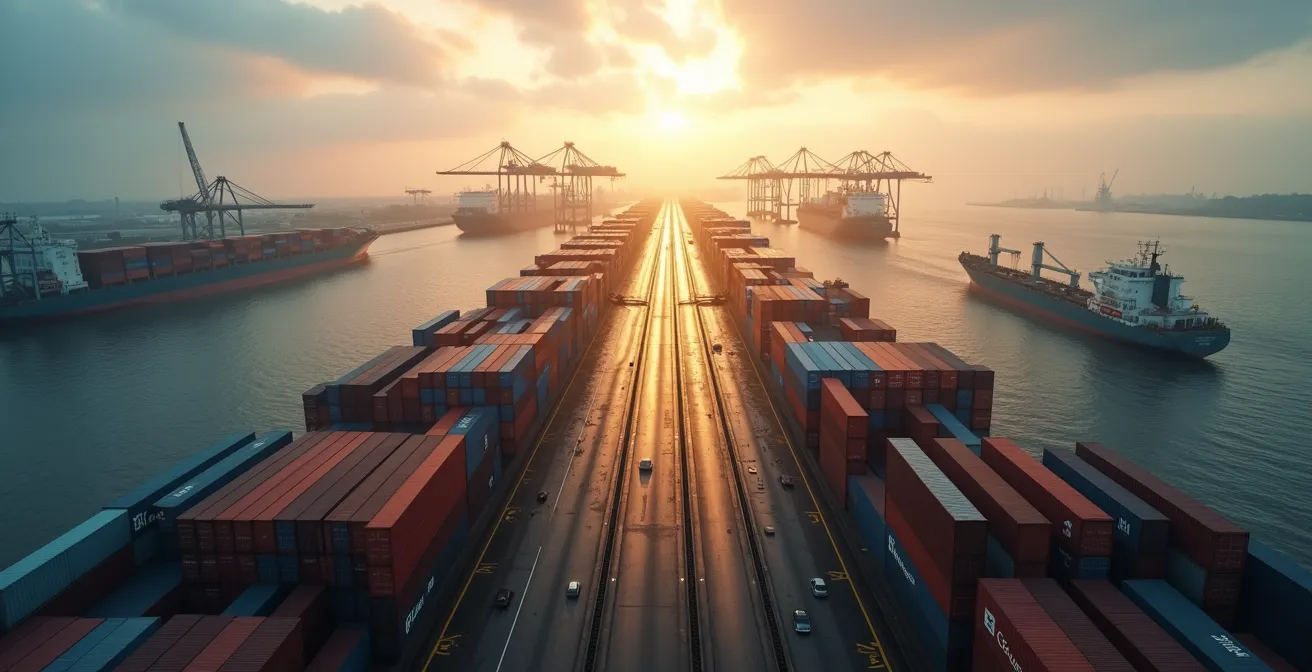
To navigate this process, a clear understanding of the documentation is essential. According to the Canadian Trade Commissioner Service, several key documents are mandatory for a smooth export journey. Below is a summary of the core requirements to ensure your goods clear customs without issue, as detailed in their comprehensive export guide for the EU.
| Document Type | Requirement | Key Considerations |
|---|---|---|
| Business Number (BN) | Mandatory | The Canada Border Services Agency (CBSA) requires all exporters of commercial goods to have a Business Number assigned by the Government of Canada. |
| Single Administrative Document (SAD) | Required for EU entry | All goods imported into the EU must be declared to the customs authorities of the country of import using the SAD. |
| Origin Declaration | Required for CETA benefits | Canadian exporters are required to make an origin declaration on invoices or any other commercial documents that describes the originating product in sufficient detail. |
| Export Declaration | Required for goods >$2,000 | If your commercial shipments are valued at more than $2,000 (CDN) and are exported to a country other than the United States, you must report the export to CBSA. |
US vs. EU: Which Export Market Is Easier for Canadian SMEs?
The default path for Canadian exporters is south. The US market feels easier due to its proximity, shared language, and cultural similarities. However, “easier” does not always mean “better” or more profitable in the long run. When comparing the US and EU markets, it becomes clear that they offer different types of opportunities and challenges. The choice between them is a matter of strategic arbitrage—understanding which market’s characteristics best align with your company’s strengths and long-term goals. While the US is a single, large, relatively homogenous market, the EU operates as a single market with common rules but is comprised of 27 distinct cultural and linguistic landscapes.
This distinction is critical. A sales approach that works in the US can be deployed nationwide with minor tweaks. In Europe, an approach that resonates in Germany may fail completely in Spain. This perceived complexity, however, can be a strength. It forces a business to become more agile and customer-centric. Furthermore, the EU’s regulatory environment, though stringent, is often harmonized. Once you meet the standard for one country, you’ve often met it for all. This contrasts with the US, where a product might need to comply with a patchwork of different state-level regulations in addition to federal ones.
Perhaps the most significant long-term advantage of the EU is its robust intellectual property (IP) protection. Patents, trademarks, and copyrights are rigorously enforced across the Union, providing a secure environment for innovative products. For Canadian SMEs, Europe is not a secondary option; it’s a primary growth vector. A recent BDC analysis shows that 8,552 Canadian SMEs exported to Europe, outpacing the number exporting to Asia and underscoring its importance as a diversification hub.
| Factor | United States | European Union |
|---|---|---|
| Market Size | Single large market | EU’s single market establishes common rules for many products and services. |
| Trade Agreement | CUSMA/USMCA | CETA eliminates almost all tariffs and significantly reduces regulatory barriers. |
| Regulatory Environment | Federal and state regulations | Stringent regulations—particularly within industries like food and beverage or when dealing with data privacy. |
| Cultural Diversity | Relatively homogeneous | Europe’s cultural diversity means that a sales approach that works in one country may fall flat in another. |
| IP Protection | Strong but litigious | Europe’s robust intellectual property protections are a major advantage. Patents, trademarks and copyrights are rigorously enforced across the EU. |
The Localization Mistake That Can Offend Your European Clients
Assuming that a high-quality product and competitive pricing are enough to succeed in Europe is a frequent and costly mistake. The single biggest error Canadian companies make is underestimating the need for deep localization, which goes far beyond simple translation. This is not just about language; it’s about respecting business culture, adapting your sales approach, and demonstrating that you have done your homework. Presenting in English might be acceptable in the Netherlands or Nordic countries, but it can be seen as arrogant or lazy in others. As Agriculture and Agri-Food Canada notes in its guide, the expectation varies significantly.
In certain EU markets like France, Germany, Spain and Italy your presentation needs to be in the local language. In The Netherlands, Belgium and the Nordic countries presentations can be in English.
– Agriculture and Agri-Food Canada, Exporting Agri-food products to the European Union guide
This “cultural granularity” is where deals are won and lost. A generic, one-size-fits-all sales pitch focused on product features will fall flat. European buyers expect you to understand their specific business needs, their customers, and the gaps in their current offerings. Your pitch must be a consultation, not a presentation. It should clearly articulate the value you bring to *their* specific context. This requires thorough research and a willingness to tailor your approach for each significant market.
The visual metaphor of different coffee styles on a boardroom table represents the nuanced cultural differences in European business meetings—a detail that successful exporters must master.

Building this level of trust is paramount. Mentioning credentials from other markets, providing case studies, and demonstrating credibility are essential steps. It shows that you are a serious, long-term partner, not an opportunistic seller. To avoid making a critical localization error, a pre-launch audit is essential.
Your Pre-Launch European Localization Audit
- Presentation & Language: Confirm the required language for presentations and key documents in your target market. Is English acceptable or is local language mandatory?
- Sales Approach: Shift your pitch from ‘product + price’ to a consultative approach. Identify the buyer’s specific needs and articulate how your product solves their problem.
- Credibility Package: Compile case studies, testimonials, and credentials from other markets to build trust and endorse your claims.
- Packaging & Compliance: Investigate multi-lingual packaging options to achieve economies of scale (e.g., French/Dutch for Benelux and France). Ensure all labelling meets EU standards.
- Gap Analysis: Demonstrate a deep understanding of the buyer’s business by clearly identifying their current gaps and showing precisely how your company will fill them.
When to Hedge Currency Risks: Protecting Margins Against a Fluctuating Euro
Once you’ve secured your first European order, the strategic challenges shift from market entry to financial management. One of the most critical is currency risk. With EU-Canada bilateral trade reaching over €125 billion in goods and services, even small fluctuations between the Canadian Dollar and the Euro can have a massive impact on your bottom line. A 5% swing in the exchange rate can wipe out an entire profit margin if you’re not prepared. This makes currency hedging not a task for the finance department, but a core strategic decision for any exporter.
The question is not *if* you should manage currency risk, but *when* and *how*. For small, infrequent transactions, the cost of hedging might outweigh the benefits. You might simply price your goods in Canadian dollars and transfer the risk to the buyer. However, as your export volume grows, this approach becomes untenable. You will likely need to invoice in Euros to be competitive, which means you are now exposed to foreign exchange (FX) volatility. The period between when you agree on a price and when you receive payment is a window of risk.
This is the point where a formal hedging strategy becomes essential for margin defence. The goal is not to speculate on currency movements but to lock in a specific exchange rate for future transactions, thereby guaranteeing your profit margin. Tools like forward contracts (agreeing to exchange a set amount of currency on a future date at a predetermined rate) provide certainty. For Canadian SMEs, institutions like Export Development Canada (EDC) are crucial partners. They provide not only financing and insurance but also expert guidance on managing FX risk. As CETA has opened doors, EDC has seen a surge in companies seeking help, highlighting that diversification is now a necessity, and managing its financial complexities is part of the package.
Case Study: EDC’s Foreign Exchange Support for Canadian SMEs
Export Development Canada (EDC) provides comprehensive support for businesses dealing with currency risks. Following the implementation of CETA, EDC’s regional vice-president for Europe noted they were ‘flooded with calls from companies looking for help entering new markets’ as ‘Canadian companies have realized that diversifying their export markets is no longer just a nice to have’. To mitigate the financial complexities of Euro-denominated transactions, EDC offers a full suite of credit insurance products and FX support designed to lower the risk of doing business abroad, enabling SMEs to protect their margins and export with confidence.
Why Products That Work in the US Often Fail in Canada?
Before a Canadian company can confidently tackle the 27 distinct markets of the EU, it must first master the complexities within its own borders. The belief that Canada is simply a smaller, colder version of the United States is a dangerous oversimplification that has led countless US products to fail here. This internal lesson in market nuance serves as the perfect training ground for any future European expansion. The primary reason for failure is ignoring Canada’s deep-seated regional and cultural diversity, particularly the distinct reality of Quebec.
Quebec is not just a French-speaking province; it’s a nation with its own consumer culture, media landscape, and legal requirements. A marketing campaign that resonates in California will likely be ignored or even ridiculed in Montreal if it’s merely translated without cultural adaptation. The legal requirement for French-language prominence on packaging (under Bill 96 and its predecessors) is a non-negotiable barrier to entry. Companies that treat bilingual packaging as an afterthought, rather than a core part of their product design, signal to 8 million consumers that they are not a priority. This is the exact same mistake businesses make when entering France or Spain from an Anglophone-centric mindset.
Beyond Quebec, Canada’s regional economic identities create further fragmentation. The resource-driven economy of Alberta fosters a different consumer ethos than the finance and tech hubs of Toronto or the public-sector focus of Ottawa. Tastes, brand loyalties, and price sensitivities vary dramatically from the Atlantic provinces to British Columbia. A business that learns to create flexible marketing, distribution, and product strategies to succeed across Canada is inadvertently building the exact muscles required to navigate the even greater diversity of the European Union. Mastering your home turf is the first step in de-risking your global ambitions.
How to Use Vancouver as a Hub for Exporting to Asian Markets?
While this guide focuses on the strategic imperative of EU expansion, a truly resilient Canadian business diversifies its diversification. Looking east to Europe should be complemented by looking west to Asia. In this context, Vancouver is not just a major Canadian city; it is North America’s most vital gateway to the Asia-Pacific region. Its strategic advantages are built on a powerful combination of geography, infrastructure, and demographics.
Geographically, the Port of Vancouver is closer to key Asian ports like Shanghai, Tokyo, and Busan than any other major port on the continent. This translates into shorter shipping times and lower fuel costs, a direct competitive advantage for goods exporters. The port’s world-class infrastructure and rail connections to the rest of Canada and the US mean that a manufacturer in Ontario or Alberta can efficiently route their goods through Vancouver to access Asian markets. This logistical efficiency is the western equivalent of using Rotterdam as a gateway to the EU.
Furthermore, Vancouver’s deep cultural and demographic ties to Asia create a unique business ecosystem. A significant portion of its population has roots across the Pacific, fostering a deep, nuanced understanding of Asian business cultures and creating invaluable networks. This “human infrastructure” is a powerful asset for navigating complex markets. Finally, trade agreements like the Comprehensive and Progressive Agreement for Trans-Pacific Partnership (CPTPP) provide Canadian businesses with preferential access to key markets, including Japan, Vietnam, and Australia. Using Vancouver as a base of operations allows a company to fully leverage the logistical, cultural, and political advantages needed to succeed in the world’s fastest-growing economic region.
Key Takeaways
- CETA is a strategic tool for competitive advantage, offering more than just tariff removal through procurement access and regulatory alignment.
- Adopt a “logistical gateway” strategy by using a single, efficient EU entry point like Rotterdam to simplify compliance and distribution across the single market.
- Treat the EU’s regulatory and cultural complexity as an opportunity to build a “moat” around your business, rather than as a barrier.
How to Succeed in Vancouver’s Real Estate-Driven Business Landscape?
After mastering global logistics, multi-market localization, and international trade agreements, the final strategic challenge for many Canadian businesses is a domestic one: the cost of doing business on the ground. Nowhere is this more acute than in Vancouver, where the business landscape is inextricably linked to its real estate market. Succeeding in this environment requires a business model that is deliberately insulated from the pressures of high commercial and residential property costs.
The most direct impact is on talent. With some of the highest housing costs in the world, attracting and retaining skilled employees in Vancouver is a major challenge. Businesses must either offer significantly higher salaries—compressing their own margins—or embrace highly flexible or fully remote work models. This pressure forces companies to be exceptionally efficient with their physical footprint. The era of the large, centralized downtown office is giving way to smaller, collaborative hubs or completely distributed teams. This has profound implications for company culture, collaboration, and cybersecurity.
This economic reality actively filters the types of businesses that can thrive. Industries with low margins, heavy physical footprints, or a reliance on a large, localized, moderately-paid workforce face immense pressure. Conversely, the environment selects for businesses with high-value, low-footprint models. This includes software and tech companies, specialized professional services (engineering, law, finance), and exporters of high-margin intellectual property or niche physical goods. In a sense, the high cost of real estate forces Vancouver businesses to adopt a global, high-value mindset from day one, as competing on local volume is often unsustainable. Success in this landscape is about maximizing the value generated per square foot and per employee, a discipline that serves any company well on the global stage.
To apply these strategic frameworks to your specific situation, the next logical step is to conduct a personalized assessment of your export readiness and market opportunities.