
The modern business dinner is not a meal; it is a meticulously orchestrated stage for influence and the final frontier for closing high-ticket deals.
- Success hinges on “relationship architecture”—transforming a transactional event into a personal connection.
- Subtle strategies, from strategic seating at a gala to the timing of your business discussion, have a greater impact than any sales pitch.
Recommendation: Stop viewing client dinners as an entertainment expense and start treating them as a strategic investment in relationship equity, with a quantifiable return.
For the senior executive, the business dinner is a familiar ritual. You’ve likely attended hundreds, mastered basic table manners, and know the cardinal rule: the host pays. Conventional wisdom dictates booking a reputable restaurant, engaging in polite small talk, and perhaps, if the mood is right, gently steering the conversation toward business over dessert. This approach is safe, standard, and utterly insufficient for securing high-ticket deals in today’s competitive landscape.
The common advice focuses on avoiding embarrassing missteps, but it misses the profound strategic opportunity at hand. What if the choice of venue, the arrangement of seats, and the moment you transition from personal to professional were not just matters of etiquette, but calculated moves in a sophisticated game of influence? The true key to leveraging these encounters lies not in following a century-old script, but in mastering the art of strategic relationship architecture. It’s about transforming an obligatory meal into a powerful, personal touchpoint that builds trust and closes deals long before the formal proposal is sent.
This guide moves beyond the platitudes. We will deconstruct the business dinner, revealing how to use every element—from physical positioning to financial justification—as a tool. We will explore the subtle dynamics of seating, the art of hosting with a personal touch, the strategic timing of negotiation, and the critical importance of calculating the return on this powerful networking investment.
To navigate this complex but rewarding terrain, it’s essential to understand each component of a successful high-stakes dinner. This article is structured to guide you through every stage, from macro-strategy to micro-execution, providing a clear roadmap for transforming your next client meal into a definitive success.
Summary: Mastering the Art of the High-Stakes Business Dinner
- Why Where You Sit at a Gala Table Changes the Conversation?
- How to Host a Client Dinner That Feels Personal, Not Transactional?
- Business Lunch vs. Dinner: Which Is Better for Negotiation?
- The Risk of Drinking Too Much at Professional Events
- How to Pivot From Small Talk to Business Naturally?
- The Networking Mistake That Makes Mentors Ghost You
- The Communication Mistake That Makes Investors Suspect the Worst
- How to Calculate the ROI of Your Networking Activities?
Why Where You Sit at a Gala Table Changes the Conversation?
At a high-profile gala or a large corporate dinner, your seat is not just a place to eat; it is the most fundamental tool of your networking strategy. The physical dynamics of a room directly dictate the flow of influence and information. Proximity to the host, access to key decision-makers, or even a position that offers a commanding view of the room can fundamentally alter the conversations you have and the opportunities you can create. Being passive about seating is ceding control of your evening’s outcome before the first course is even served. A study of corporate galas as networking opportunities confirms that venue selection and seating arrangements are crucial factors that determine the tone and success of the entire event.
The strategic executive views a seating chart not as a directive, but as a map of power. Your goal is to position yourself at the intersection of influence and access. This requires proactive planning, whether it involves communicating with the event organizer beforehand or making a swift, calculated choice upon entering the room. The concept is to move from a position of passive attendance to one of active strategic positioning.
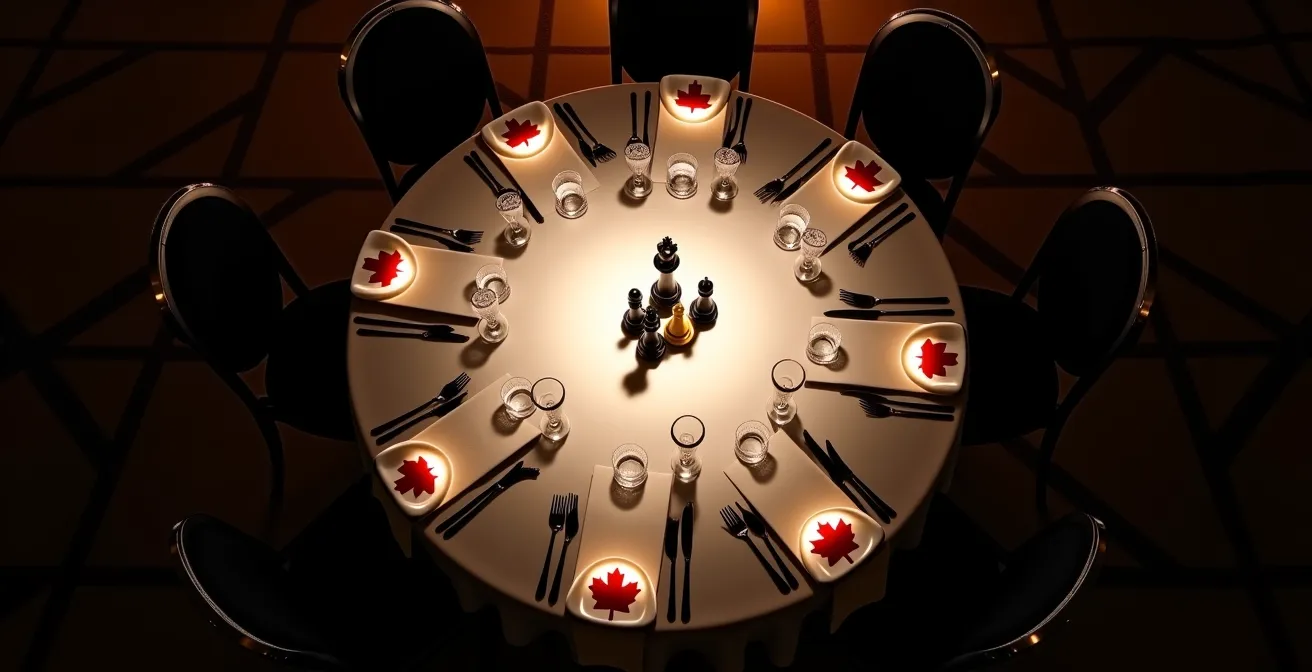
As the illustration suggests, a round table is a landscape of subtle power dynamics. The seat next to a senior partner or a potential investor is prime real estate. An effective approach is the “anchor and explorer” method: one member of your team secures a conversation with a key target (the anchor), while another circulates to gather intelligence and create secondary introductions (the explorer). This transforms a static dinner into a dynamic intelligence-gathering operation, maximizing your team’s presence and reach. Every seat holds potential, but only if you actively manage its strategic value.
Your Action Plan: Power Seating Strategies for Canadian Business Galas
- Strategic Positioning: Position yourself strategically at roundtable discussions during major Canadian events like Invest Canada conferences. Don’t just take the nearest available seat.
- Leverage Hosted Events: Actively use hosted roundtables and dedicated networking breaks to meet leading players in Canadian venture capital and other key industries.
- Access Decision-Makers: Choose seats that facilitate direct access and sustained conversation with decision-makers managing significant assets or influence.
- Employ the ‘Anchor and Explorer’: Implement the anchor and explorer approach where one team member maintains a key conversation while another scouts for new opportunities and connections.
- Maximize Hybrid Formats: Take full advantage of hybrid gala formats that combine physical and virtual components to extend your networking reach beyond the room.
How to Host a Client Dinner That Feels Personal, Not Transactional?
Hosting a client dinner is a declaration of intent. A transactional dinner feels like an obligation—a generic steakhouse, a perfunctory conversation, an exchange of business cards. A personal dinner, however, feels like a privilege. It communicates respect, thoughtfulness, and a genuine interest in the relationship beyond the deal. This distinction is the bedrock of building the deep trust required for high-ticket sales. The goal is to create an experience so bespoke that the client feels seen and valued as an individual, not just as a prospective account. This requires moving beyond basic hospitality to meticulous, personalized orchestration.
The first step is research. Before booking a table, understand your guest’s preferences. Are they a wine connoisseur, a fan of a particular cuisine, or someone who values discretion and quiet ambiance? Choosing a restaurant that reflects their tastes sends a powerful, unspoken message: “I’ve paid attention.” With the average Canadian now spending CA$63 per restaurant visit, a significant increase from previous years, every dollar must contribute to this personalized experience. Arriving early to confirm arrangements with the maître d’ and pre-settling the bill ensures the evening flows seamlessly, free from awkward transactional moments like pulling out a credit card.
In the Canadian context, this personal touch often extends to language. Hosting a client in Montreal or Ottawa and proactively requesting a bilingual menu is a small gesture that demonstrates immense cultural awareness and respect. The entire evening should be curated to remove friction and amplify connection, transforming a standard business meal into a memorable, relationship-building event.
This table outlines the critical shift in mindset from a standard business meal to a strategically personal one.
| Hosting Element | Transactional Approach | Personal Approach |
|---|---|---|
| Venue Selection | Generic business restaurant | Host chooses an appropriate restaurant and makes reservations ahead of time based on guest preferences |
| Preparation | Basic reservation only | Research guest preferences, arrive early to arrange details with staff |
| Gift Giving | Corporate branded items | Personalized gift referencing conversation topics or shared interests |
| Language Consideration | Single language assumption | Bilingual menu preparation for Montreal/Ottawa meetings |
Business Lunch vs. Dinner: Which Is Better for Negotiation?
The choice between a business lunch and a business dinner is not a matter of convenience; it is a strategic decision that defines the encounter’s pace, tone, and potential outcome. Each format serves a distinct purpose in the deal-making process. The business lunch is an instrument of efficiency, while the dinner is a vehicle for relationship-building and deep negotiation. Understanding when to deploy each is crucial for any senior executive. As post-pandemic data shows, Canadians have returned to restaurants with enthusiasm, with sales reaching $8.2 billion in October 2024, making these in-person meetings more relevant than ever.
Breakfast and lunch are constrained by the business day. Conversations are typically more direct and time-bound. A breakfast meeting might last an hour, forcing discussions to begin quickly. Lunch allows for a slightly longer format of around 90 minutes, with business talk often best initiated after ordering to avoid interruption from service staff. These formats are ideal for advancing an existing conversation, clarifying specific points, or maintaining momentum on a deal already in progress. They are tactical, not foundational.
Dinner, by contrast, operates outside the confines of the workday. It is inherently more social and less rushed, with a two-to-three-hour timeframe allowing for a natural progression from personal rapport to professional substance. This extended format is indispensable for two scenarios: building a relationship from scratch with a new high-value client or conducting the final, delicate stages of a major negotiation. The relaxed atmosphere fosters the trust and candor necessary to navigate complex issues. Business should be reserved for after the main course, typically over coffee or dessert, allowing ample time to establish a genuine connection first. Choosing dinner is choosing to invest time in the relationship architecture that underpins the most significant deals.
The Risk of Drinking Too Much at Professional Events
In a high-stakes professional setting, alcohol is not a tool for relaxation; it is a variable that must be managed with strategic precision. While sharing a drink can help build rapport, excessive consumption is one of the fastest ways to erode credibility, reveal confidential information, and sabotage a deal. The risk is not merely appearing unprofessional; it’s about compromising your cognitive function when it matters most. Your ability to read the room, articulate complex ideas, and make sound judgments diminishes with every glass. For a senior executive, maintaining unimpeachable control is non-negotiable.
The rule is simple: moderation is a demonstration of discipline. A strict personal limit, such as one or two glasses of wine for the entire evening, is not a sign of austerity but of focus. This ensures you remain sharp and fully in command of your faculties. An effective tactic is to alternate each alcoholic beverage with a full glass of water, which not only paces your consumption but also keeps you hydrated and alert. You should always pace yourself, even if your host or other guests are drinking more freely. Your priority is the business outcome, not keeping up.
Engaging the sommelier can be a strategic move. Rather than simply ordering a drink, you can ask for their recommendation on a prestigious but perhaps lower-alcohol wine, demonstrating sophistication while adhering to your strategy. This positions you as a connoisseur, not just a consumer. Ultimately, your relationship with alcohol at a business dinner should be one of careful, deliberate control, ensuring that it remains a minor social lubricant rather than a major liability.

How to Pivot From Small Talk to Business Naturally?
The transition from casual conversation to business discussion is the most delicate moment of a client dinner. A clumsy, abrupt pivot can make the entire preceding rapport-building feel disingenuous—a mere formality before the sales pitch. Conversely, waiting too long can lead to a missed opportunity, with the evening ending before key topics are addressed. The art lies in finding a natural, seamless bridge that feels like a logical continuation of the conversation, not a jarring shift in agenda. This requires situational awareness and a sensitivity to the rhythm of the meal.
The most widely accepted and effective transition point in Canadian business culture is during the dessert and coffee service. By this stage, the main social component of the meal is complete, guards are lowered, and a more focused conversation feels appropriate. The key is to use a “bridge phrase” that connects the social to the professional. Instead of an abrupt “So, about the deal…,” a more sophisticated approach is to link back to a point made earlier in the conversation. For example: “Now that we’re settled with coffee, I’d love to revisit the point you made earlier about market expansion. It was fascinating, and it connects to an idea I wanted to share.”
Case Study: The Dessert and Coffee Transition Strategy
Canadian business culture recognizes the dessert and coffee service as the accepted moment to transition to business discussions. Professionals use specific phrasing like ‘Now that we’re settled with coffee, I’d love to revisit that point you made earlier about…’ This creates a natural bridge from social to professional conversation while respecting the meal’s progression and allowing guests to feel comfortable with the timing. This technique respects the social contract of the meal while effectively opening the door for substantive discussion, ensuring the pivot feels both organic and intentional.
This method accomplishes two critical goals: it shows you were actively listening, and it frames the business topic as an extension of their interests, not your own agenda. By anchoring the pivot in your guest’s own words, you make them a co-author of the transition, ensuring it feels collaborative rather than confrontational. This strategic subtlety is what separates an amateur pitch from an executive-level negotiation.
The Networking Mistake That Makes Mentors Ghost You
The principles of high-stakes client dinners apply equally to another critical relationship: the one with a mentor. Senior executives often seek guidance from seasoned veterans, but many sabotage these potential relationships by treating a mentor dinner as a free consulting session. This transactional approach—expecting a wealth of advice in exchange for a meal—is the single biggest mistake that leads to being “ghosted.” Mentors, like high-value clients, respond to genuine connection and respect, not to a one-sided extraction of value.
In Canadian business culture, there is a strong preference for sincerity over overt sales pitches, and the same holds true for networking. A follow-up thank-you email that references a specific part of the conversation is deeply appreciated. The relationship must be framed as one of mutual respect, not deference. While it is important to show gratitude for their time, being overly meek or constantly apologizing can be perceived as a lack of confidence, which is off-putting. The goal is a peer-level exchange, even if there is an experience gap. Present your questions and ideas in a calm, polite, and confident manner.
The most effective way to build a lasting mentor relationship is to shift the dynamic from “taking” to “giving.” Frame the dinner as a gesture of gratitude for past advice. Come prepared not with a long list of problems to solve, but with an update on how you’ve implemented their previous suggestions. Ask for one key piece of advice on your next step. Crucially, find something to offer in return—an interesting article, a relevant introduction, or a unique insight from your own field. This transforms the meeting from a transaction into a reciprocal partnership, ensuring the mentor feels valued and is eager for the next conversation.
The Communication Mistake That Makes Investors Suspect the Worst
When dining with a potential investor, every action is scrutinized. Investors are not just evaluating your business plan; they are assessing your character, judgment, and financial discipline. In a climate where 84% of foodservice companies reported lower profits in 2023 than in 2019, with many operating at a loss, investors are more risk-averse than ever. They are looking for red flags, and the dinner table is a prime location to spot them. The most significant communication mistake is not what you say, but what your non-verbal actions convey about your relationship with money and attention to detail.
Ordering the most expensive item on the menu, for example, is a classic red flag. To an investor, this doesn’t signal a taste for the finer things; it signals carelessness with money—their potential money. Similarly, poor table manners, such as placing used silverware back on the table, can be interpreted as a lack of attention to detail. If you are sloppy with small rules of etiquette, they may wonder if you are equally sloppy with the fine print of a contract or the details of a financial projection.
Your communication style is also under a microscope. Using excessive jargon or buzzwords can be seen as a sign of insecurity, an attempt to mask a lack of substance. Clear, direct, and confident communication is always more impressive. Perhaps the most telling indicator is how you treat the service staff. Treating a waiter with dismissiveness or arrogance is a major character flaw in the eyes of an investor. Conversely, treating them with respect demonstrates leadership, humility, and emotional intelligence—qualities essential for anyone they would entrust with their capital.
The following table highlights common behaviors and how they are perceived by a discerning investor, providing a clear guide on what to avoid and what to embrace.
| Behavior | Red Flag Impact | Green Flag Alternative |
|---|---|---|
| Menu Ordering | Ordering the most expensive item signals carelessness with money | Order moderately priced items similar to others at the table |
| Utensil Handling | Poor table manners suggest lack of attention to detail | Once silverware is used, it never touches the table again; rest it on the sides of your plate |
| Communication Style | Excessive jargon interpreted as insecurity | Clear, direct communication without buzzwords |
| Service Staff Interaction | Dismissive behavior raises character concerns | Respectful treatment demonstrates leadership qualities |
Key Takeaways
- Seating is Strategy: Your position at a table is a tool of influence. Actively manage where you sit to maximize access to key decision-makers.
- Personalization Builds Trust: A dinner that feels bespoke and thoughtful is infinitely more powerful than a generic, transactional one. Research your guest to create a memorable experience.
- Moderation Signals Discipline: Your handling of alcohol is a direct reflection of your judgment and self-control. A strict limit is a sign of focus, not weakness.
How to Calculate the ROI of Your Networking Activities?
For a business dinner to be considered a strategic investment rather than a mere expense, its return must be measured. However, calculating the ROI of a networking activity goes far beyond simply comparing the cost of the meal to the value of a signed contract. The true return is a composite of immediate revenue, long-term relationship equity, and strategic intelligence. With the Canada Food Service Market projected to grow at a CAGR of 17.5% through 2030, the investment in relationship-building activities is substantial, and justifying it requires a sophisticated framework.
A multi-factor ROI model provides a more holistic view. First, track the Direct Deal Value—any immediate revenue that can be directly attributed to the meeting. Second, measure the Relationship Equity gained. This involves assigning a value to the access you’ve secured with C-level executives or key influencers, which can be monetized in the future. Third, quantify the Strategic Intelligence acquired during the conversation, such as insights into a competitor’s strategy or a new market opportunity.
Furthermore, it’s essential to calculate the Future Referral Potential and apply Canadian tax considerations. Under CRA guidelines, you can typically deduct 50% of meal and entertainment expenses, which must be factored into the net cost of the activity. Finally, a powerful metric is comparing your ROI to the COI—the Cost of Inaction. How many deals might have been lost without the rapport and trust built over these dinners? When viewed through this comprehensive lens, the strategic business dinner is often revealed to be one of the highest-return investments an executive can make.
By shifting your perspective from simple etiquette to strategic architecture, you transform every business meal into a powerful opportunity. The dinner table becomes your stage for building influence, demonstrating character, and ultimately, closing the deals that define your success. Your next dinner invitation is not just a calendar entry; it’s a strategic move waiting to be made.