
Success in Vancouver hinges on strategically leveraging its high costs as a justification for premium, globally-competitive services—not just surviving them.
- Transform mandatory sustainability investments into a “Green Premium” brand asset that attracts high-value clients.
- Justify top-tier salaries by building “Cross-Pacific Competency” that makes your service indispensable for Asian market entry.
Recommendation: Stop competing on price; start competing on the unique value proposition that only a sophisticated, Vancouver-based service provider can offer the world.
For any service provider, the first look at a commercial lease in Vancouver can be a moment of profound sticker shock. The city’s real estate market isn’t just a local talking point; it’s a gravitational force that shapes every aspect of the business landscape. The immediate reaction is to focus on cost-cutting, to search for efficiencies that can make the astronomical overhead manageable. This is a survival instinct, but it’s a strategic dead end. The common advice—that Vancouver is a ‘gateway to Asia’ or a ‘booming tech hub’—often feels disconnected from the daily reality of managing cash flow in one of North America’s most expensive cities.
These platitudes, while true, miss the fundamental point. They treat Vancouver’s characteristics as separate features rather than an interconnected system. The high cost of living, the demanding regulatory environment for sustainability, the proximity to Asian markets, and the competition for talent are not independent challenges. They are symptoms of a single, underlying reality: Vancouver is a premium market. And in a premium market, competing on price is a losing game. The real question isn’t how to survive the high costs, but how to reframe your entire business model to justify them.
The key is a strategic shift from cost mitigation to value arbitrage. It’s about leveraging the very factors that drive up costs—sustainability, a world-class talent pool, and a strategic global position—and transforming them into a premium, exportable service that commands higher prices on the global stage. This isn’t about being cheaper; it’s about being unequivocally better, more responsible, and more connected. This requires a new playbook, one that turns regulatory burdens into brand assets and time zone challenges into competitive advantages.
This article will provide a strategic roadmap for service providers to thrive in Vancouver’s unique economy. We will explore how to convert sustainability into a non-negotiable asset, use the city as a strategic hub for Asian and European exports, manage talent and operations across time zones, and make critical infrastructure decisions that align with this premium positioning.
Summary: A Playbook for Vancouver Business Success
- Why Sustainability Is a Non-Negotiable Requirement for Vancouver Businesses?
- How to Use Vancouver as a Hub for Exporting to Asian Markets?
- Vancouver vs. Victoria: Is the Island a Viable Option for Tech Companies?
- The Salary Mistake That Causes Vancouver Talent to Flee to the US
- How to Manage a Vancouver Team While Clients Are in Toronto (3-Hour Gap)?
- How to Logistics: Shipping Products from Canada to Europe Without Headaches?
- Solar vs. Geothermal: Which Retrofit Saves More for Commercial Buildings?
- How to Prepare Your Canadian Business for Exporting to the EU?
Why Sustainability Is a Non-Negotiable Requirement for Vancouver Businesses?
In Vancouver, sustainability is no longer a marketing buzzword; it’s a core component of your operational license. The province’s aggressive climate targets, embodied by programs like CleanBC, create a regulatory environment where environmental performance is intrinsically linked to financial performance. For a service provider, viewing this as a mere compliance cost is the first strategic error. The real opportunity lies in embracing this requirement and marketing it as a “Green Premium”—a verifiable mark of quality that resonates with a growing segment of global clients who demand sustainable supply chains. This isn’t just about feeling good; it’s about commanding better prices.
The provincial government is actively funding this transition, turning what could be a capital burden into a subsidized upgrade. Since 2019, an impressive $244 million has been invested through the CleanBC Industry Fund, projected to cut 9 million tonnes of emissions. This demonstrates a clear government partnership model. Businesses that align with these goals are not just avoiding future carbon taxes; they are accessing capital to become more efficient and marketable. This public investment de-risks the move towards greener operations, making it a sound financial decision, not just an ethical one.
The practical application of these funds shows the scale of what’s possible. Consider the City of Vancouver’s landfill project, which offers a powerful template for how industrial-scale environmental problems can be turned into assets.
Case Study: Vancouver Landfill Methane Capture
The City of Vancouver secured over $6 million from the CleanBC Industry Fund for a significant expansion of its methane capture system at the local landfill. This single project is expected to eliminate over 716,000 tonnes of CO2 equivalent emissions by 2033. For a service provider, this isn’t just an infrastructure project; it’s a signal. It shows that large-scale, measurable, and verifiable emissions reduction is the new standard of business in the region, creating a market for expertise in green engineering, project management, and compliance reporting.
By investing in and documenting your own sustainable practices—whether through building retrofits, supply chain audits, or reduced operational waste—you are building a value proposition that is difficult for competitors in less-regulated jurisdictions to replicate. You are, in effect, building a business that is pre-certified for the future global economy.
How to Use Vancouver as a Hub for Exporting to Asian Markets?
Vancouver’s status as the “Pacific Gateway” is its most obvious strategic asset, but simply being on the coast is not a business strategy. The true advantage comes from developing Cross-Pacific Competency—a deep, operational expertise in navigating the logistics, cultures, and time zones that connect North America to Asia. For service providers, this means positioning yourself not just as a Canadian company, but as the essential bridge for North American businesses looking to enter Asian markets, and vice-versa. Your high Vancouver-based costs become justified by your irreplaceable local knowledge and connections.
The Port of Vancouver is the physical manifestation of this connection, a constant reminder of the flow of goods and capital. But the real value lies in the sophisticated ecosystem of services that has built up around it: freight forwarders, customs brokers, international law firms, and multilingual marketing agencies. As a service provider, your role is to integrate into this ecosystem and offer a higher-level strategic function. This could mean providing AI-driven logistics optimization, cross-cultural branding consultation, or specialized project management for complex international rollouts. Your address becomes a mark of your expertise.
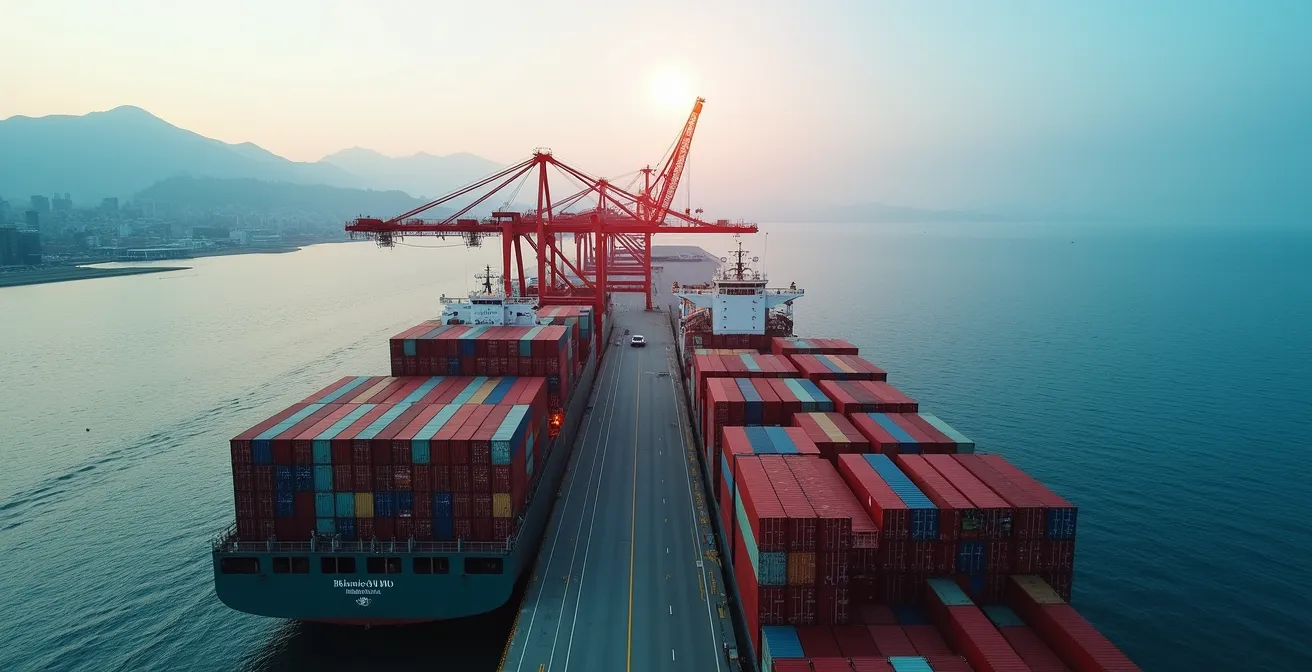
This visual of the port underscores the sheer scale of the opportunity. Each container represents a complex transaction requiring a chain of high-value services. The challenge for a Vancouver business is to move from being a simple link in that chain to becoming the strategist that designs the chain itself. This involves understanding tariff codes as well as cultural nuances, and being able to advise a client in Toronto on the best way to structure a deal with a partner in Seoul. This is the value arbitrage that makes a Vancouver location a powerful asset rather than a liability.
Furthermore, the city’s talent pool is uniquely suited for this role. With a large multicultural population and a strong focus on technology, Vancouver is a hub for the kind of sophisticated, globally-minded professionals needed to manage these complex relationships. By building a team with this specific competency, you create a service that is extremely difficult to outsource or replicate from a lower-cost city.
Vancouver vs. Victoria: Is the Island a Viable Option for Tech Companies?
The pressure of Vancouver’s real estate and operational costs naturally leads to a search for alternatives. Victoria, just a ferry ride away, often emerges as the primary contender. With a burgeoning tech scene and a lower cost base, the capital city presents a compelling case. However, a decision to relocate or establish a satellite office on Vancouver Island is not a simple cost-saving measure; it’s a strategic trade-off between scale and specialization. For a service provider, the choice between Vancouver and Victoria is a choice about the very nature of your business and the talent you need to attract.
Vancouver’s primary advantage is its sheer scale and depth. As one of North America’s top tech talent markets, it offers access to a massive, diverse pool of professionals specializing in high-growth global sectors like SaaS, VFX, and AI. This critical mass creates network effects that are difficult to replicate—a constant churn of ideas, talent, and capital. Victoria, while growing, operates on a smaller, more specialized scale, with strengths in specific niches like OceanTech and GovTech, benefiting from its proximity to the provincial government.
The data on talent and cost paints a clear picture of this trade-off. A side-by-side comparison reveals the strategic calculus required for any service-based business weighing its options.
| Metric | Vancouver | Victoria |
|---|---|---|
| Tech Talent Pool Size | Large (ranked 11th in North America) | Smaller, specialized |
| Average Tech Salary | $109,990 CAD | Lower cost base |
| Software Developer Salary | $120,848 CAD | Competitive but lower |
| 5-Year Wage Growth | 36.6% | Data not specified |
| Specialization | SaaS, VFX, Gaming, AI | OceanTech, GovTech |
| Core Tech Industry Employment | 51.1% in pure tech | Government proximity advantage |
This comparison, based on CBRE’s 2024 analysis of tech talent markets, shows that while Vancouver’s salaries are high, they are driven by rapid wage growth and a deep concentration in pure tech roles. Choosing Vancouver means paying a premium for access to a world-class, scalable talent engine. Choosing Victoria means opting for a more stable, potentially lower-cost environment that may be ideal for a niche service but could present challenges for rapid scaling or finding highly specialized global-facing talent.
The Salary Mistake That Causes Vancouver Talent to Flee to the US
In Vancouver’s hyper-competitive tech and service sectors, the most common mistake is assuming that salary is a simple numbers game against Seattle, San Francisco, or Austin. While compensation is critical, trying to win a bidding war with US-based firms on pure salary is often a losing proposition. The real mistake is failing to build a retention strategy around “Talent Magnetism”—a holistic value proposition that combines competitive pay with the unique, high-quality lifestyle that is Vancouver’s secret weapon. High-performing professionals don’t just work for a paycheque; they work for a life.
The challenge is severe. The allure of higher US salaries is a constant threat to retention, and the data shows a workforce that is perpetually open to new opportunities. A recent report highlights this volatility, noting that only 29% of IT workers have a high intent to stay with their current employer. This means over two-thirds of your team is potentially susceptible to being poached at any given moment. In this environment, loyalty cannot be bought with salary alone; it must be earned through a superior overall experience.
This is where Vancouver’s high cost of living can be reframed. The same mountains and ocean that drive up real estate prices are the key assets in your retention toolkit. The ability to finish work and be on a ski hill or a kayak within the hour is a benefit that a Dallas-based competitor cannot offer. Smart companies don’t just mention this on their careers page; they build their corporate culture around it, offering flexible hours, wellness stipends, and team events that actively leverage the region’s natural advantages.

The solution is not to ignore salary, but to complement it with non-monetary benefits that are uniquely compelling. This means focusing on the total employee value proposition.
Action Plan: Non-Salary Retention Strategies
- Leverage the Cost-Quality Advantage: Actively promote Vancouver’s ranking as a top market for software engineer quality relative to cost. Frame your compensation as part of a high-value, not high-cost, package.
- Emphasize Unique Lifestyle Benefits: Formalize access to BC’s outdoor recreation. Offer ski-pass subsidies, flexible “powder day” policies, or organize team hikes. Make the lifestyle an official perk.
- Implement Meaningful Hybrid Work: Go beyond simple remote work. Structure hybrid models that maximize both focused deep work from home and collaborative, culture-building time in a well-located, desirable office.
- Invest in High-Growth Roles: Attract and retain top talent by focusing on cutting-edge projects in AI and emerging tech, where engineers can command salary premiums and build future-proof skills.
- Create Transparent Advancement Paths: Address the primary reason talent leaves—lack of growth. Build and communicate clear, tangible career ladders that show a long-term future within the company.
How to Manage a Vancouver Team While Clients Are in Toronto (3-Hour Gap)?
For a Vancouver-based service provider, the three-hour time difference with the Eastern financial and corporate hubs of Toronto and Montreal is a fundamental operational reality. Many see it as a handicap—a source of missed calls, delayed responses, and a shortened collaborative window. The strategic pivot is to reframe this gap not as a problem, but as a competitive advantage: the 12-hour North American business day. By structuring your team’s workflow intelligently, you can offer clients a level of service and responsiveness that a unilocated competitor cannot match.
The key is to abandon the traditional 9-to-5 mindset and embrace a combination of synchronous and asynchronous work. The limited window of overlapping hours—typically from 9:00 AM PST to 1:00 PM PST (12:00 PM to 4:00 PM EST)—becomes a high-value, protected time for critical, real-time collaboration. All client-facing meetings, strategic workshops, and urgent decision-making should be prioritized within this four-hour block. This forces discipline and efficiency, eliminating low-value meetings that clog up the calendar.
The rest of the day is then optimized for different types of work. The Vancouver team’s morning (6:00 AM to 9:00 AM PST) can be dedicated to responding to overnight requests from the East, ensuring Toronto clients arrive at work to find progress and answers, not silence. The Vancouver afternoon (1:00 PM to 5:00 PM PST) becomes an uninterrupted block for deep, focused work—development, writing, design, or strategic planning—free from client interruptions. This is when your team can prepare for the next day, getting ahead of the curve while their Eastern counterparts are offline. The rise of structured remote and hybrid work models, with 15% of U.S. tech jobs now fully remote, has provided the tools and cultural acceptance to make this model seamless.
Implementing this requires a clear, documented strategy, not just ad-hoc adjustments. The following structure provides a blueprint for turning the time zone challenge into a powerful operational asset:
- Establish an ‘Eastern Liaison’ Role: Designate a team member to start their day at 6:00 AM PST to provide immediate coverage when the Toronto business day begins at 9:00 AM EST.
- Create a 4-Hour Overlap Window: Mandate that the hours of 9:00 AM to 1:00 PM PST are reserved for synchronous, cross-country collaboration. Protect this time fiercely.
- Master Asynchronous Documentation: Implement rigorous use of project management platforms (like Asana, Jira, or Notion) to ensure seamless hand-offs and clear status updates, eliminating the need for constant real-time check-ins.
- Leverage the “Deep Work Afternoon”: Explicitly position the Vancouver afternoon as the time for concentrated, high-value work, ensuring your team can deliver quality without constant interruption.
- Market the 12-Hour Day: Position this extended coverage to clients as a key benefit of working with your firm, highlighting your superior responsiveness and productivity.
How to Logistics: Shipping Products from Canada to Europe Without Headaches?
While Vancouver’s prime location is often associated with Asian trade, its role as a gateway to Europe is an equally critical, though more complex, part of its global function. For businesses exporting to the EU, the logistical challenge is not just distance, but navigating a multi-modal journey that often involves sea, rail, and road transport across two continents. Success requires a resilient and diversified logistics strategy that anticipates bottlenecks and leverages Canada’s unique geographic and trade advantages.
The most direct route from Vancouver to Europe via the Panama Canal is long and can be prone to delays. Therefore, a savvy Western Canadian exporter thinks continentally, not just coastally. The “land bridge” strategy, using Canada’s extensive rail network to move goods from West to East, is a cornerstone of this approach. Shipping containers from the Port of Vancouver or, even more efficiently, the Port of Prince Rupert, can be transported by rail to Halifax, where they are then loaded onto ships for a much shorter Atlantic crossing to major European ports like Rotterdam or Hamburg. This reduces ocean transit time and provides a critical alternative during disruptions on either coast.
Building a headache-free logistics plan involves several key strategic considerations:
- Multi-Port Strategy: Avoid relying on a single port. Utilize a combination of Vancouver, Prince Rupert, and even Seattle/Tacoma to build redundancy into your supply chain, protecting your business from the impact of local labour strikes or weather events.
- Leverage CETA Advantages: The Canada-European Union Comprehensive Economic and Trade Agreement (CETA) is more than a tariff-reduction tool. Use its provisions to get products pre-certified to EU standards while still in Canada, dramatically speeding up customs clearance upon arrival.
- Embrace Digital Pre-Clearance: Work closely with modern freight forwarders who can manage digital customs pre-clearance. Submitting documentation while goods are still in transit can save days, or even weeks, of idle time at the destination port.
- Contingency Planning: Model your supply chain for disruptions. What is your plan B if a West Coast port closes? What is your plan C if rail lines are congested? Having these answers ready is the difference between a minor delay and a catastrophic failure.
Ultimately, a robust Canada-to-EU logistics network is about creating options and building flexibility. It’s about seeing the entire North American continent as your toolkit for reaching global markets efficiently and reliably, turning a potential logistical nightmare into a smooth, predictable operation.
Solar vs. Geothermal: Which Retrofit Saves More for Commercial Buildings?
For a Vancouver business committed to the “Green Premium” model, retrofitting a commercial building is a tangible demonstration of that commitment. The choice of technology, however, is a critical financial and branding decision. The two leading options, solar and geothermal, offer distinct advantages and are best suited to different types of commercial operations in the specific climate of the Lower Mainland. The decision is not about which is “better” in the abstract, but which provides the best return on investment for your specific use case.
Solar panels have high visibility, making them a powerful marketing tool. They are a literal, roof-mounted statement about your company’s commitment to sustainability. However, their effectiveness in Vancouver is limited by the “marine layer”—the persistent seasonal overcast skies that can significantly reduce power generation, especially during the winter months when energy demand for heating and lighting is highest. Geothermal systems, by contrast, are invisible. They are an underground infrastructure investment, offering little in the way of visual marketing. Their key advantage, however, is their consistent, weather-independent efficiency for both heating and cooling, making them ideal for the region’s temperate climate.
The province’s CleanBC fund is actively supporting research into these technologies, signaling their long-term viability. A notable example is the investigation into advanced geothermal systems for Vancouver’s core.
Case Study: Creative Energy’s Deep Geothermal Investigation
With support from the CleanBC Industry Fund, Creative Energy is exploring the feasibility of installing a deep, closed-loop geothermal system (an “Eavor-Loop”) to power its district energy system in downtown Vancouver. This project aims to provide a consistent, carbon-free source of heating for a dense urban area. While this is a large-scale utility project, it provides a crucial proof-of-concept for the commercial viability and scalability of geothermal technology in the local environment, guiding future investments for individual commercial facilities.
The right choice depends entirely on your building’s profile and operational needs, as detailed in the following comparison.
| Factor | Solar | Geothermal |
|---|---|---|
| Vancouver Climate Suitability | Limited by seasonal overcast skies | Highly efficient for heating/cooling |
| BC Hydro Integration | Net-metering programs available | Less grid dependency |
| Visibility/Marketing Value | High – visible sustainability statement | Low – invisible infrastructure |
| Best Building Type | Large-roof warehouses, daytime use | 24/7 operations, residential towers |
| CleanBC Funding Eligibility | Multiple streams available | Feasibility studies funded |
Key Takeaways
- Embrace the “Green Premium”: In Vancouver, sustainability is not a cost but a powerful market differentiator. Leverage B.C.’s stringent environmental standards to build a brand that commands higher value globally.
- Win the Talent War with Lifestyle: Compete with high-paying U.S. markets by building a corporate culture around Vancouver’s unparalleled work-life balance. This “Talent Magnetism” is your most defensible asset.
- Master Your Geography: Turn time zone gaps and complex shipping routes into a strategic advantage by developing deep operational expertise in managing cross-continental and trans-pacific business.
How to Prepare Your Canadian Business for Exporting to the EU?
For a Canadian service provider, exporting to the European Union is one of the most significant growth opportunities available, thanks largely to the CETA trade agreement. However, this is not a market you can enter casually. The EU operates under a sophisticated and rapidly evolving regulatory framework, particularly around data privacy, consumer rights, and environmental accountability. Preparing your business for EU export is less about logistics and more about building a foundation of compliance and data traceability from day one. Failing to do so can result in market access being denied, or significant fines.
While Canada’s own standards, like the PIPEDA privacy law, are robust, they are not a direct substitute for the EU’s General Data Protection Regulation (GDPR). GDPR compliance is a non-negotiable ticket to play. Similarly, the EU’s focus on the circular economy is leading to new requirements like the “Digital Product Passport” and the Carbon Border Adjustment Mechanism (CBAM), which will require businesses to meticulously track and report the lifecycle and embedded carbon of their products and services. A Vancouver business, already immersed in B.C.’s climate-focused economy, is perfectly positioned to meet and exceed these standards, turning another regulatory hurdle into a competitive edge.
The key is to view this preparation not as a bureaucratic task, but as an essential audit of your operational maturity. By building these capabilities now, you are not only preparing for the EU market but also future-proofing your business for a global economy where transparency and accountability are the new currencies.

Your EU Export Readiness Checklist
- Data Traceability: Begin building the systems to track product/service data now. Can you prove the origin of your components or the data security of your software, as required by the EU’s upcoming Digital Product Passport?
- Carbon Measurement: Start measuring and documenting the embedded carbon in your services. This is essential for future compliance with the Carbon Border Adjustment Mechanism (CBAM).
- Funding Application: Investigate and apply for federal funding through programs like CanExport, which provides financial assistance to Canadian businesses for developing new export markets in the EU.
- GDPR Compliance: Conduct a full audit of your data practices to ensure they meet the stringent requirements of GDPR, which go beyond Canada’s PIPEDA standards in areas like user consent and data portability.
- CETA Conformity Assessment: Leverage a key CETA provision that allows your products or services to be certified to EU standards by accredited bodies within Canada, saving immense time and money upon entry to the EU market.
To effectively navigate this complex but rewarding landscape, the next logical step is to audit your business against these Pacific-centric opportunities and begin building your unique value arbitrage strategy today.